
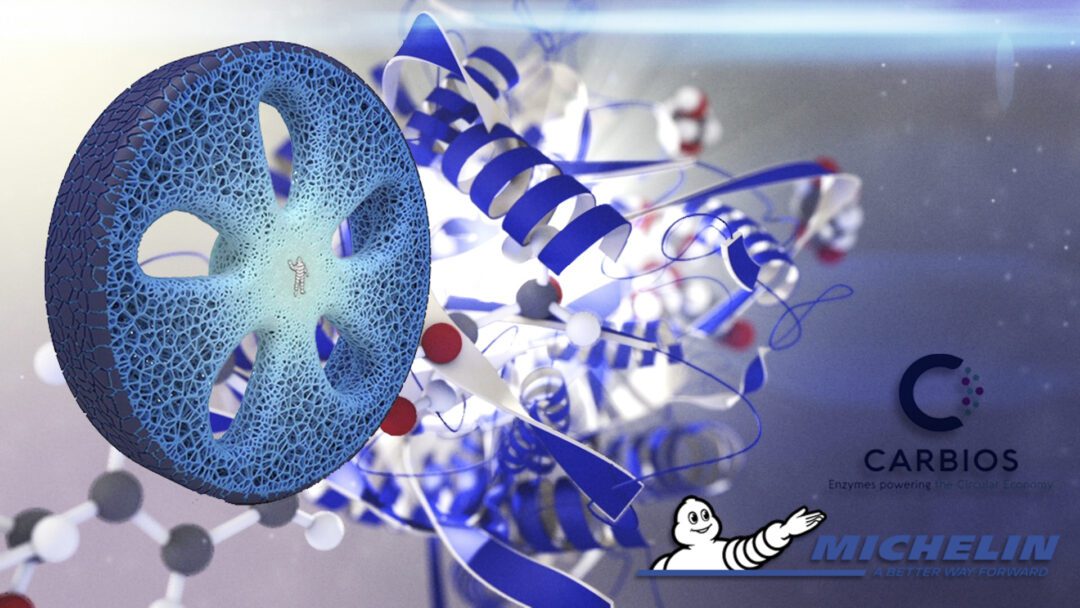
Car manufacturers in general have been franticly jumping on the EV bandwagon. Creating a car for a sustainable future ranks high of the list of their agendas. With legislations in place in some countries to produce and sell sustainable vehicles, you can understand their mad rush to develop these electron power vehicles.
French tire manufacturer, Michelin, on the other hand decided to tackle the issue of sustainability from their forte of manufacturing tires. In cooperation with French bio-industrial solutions company, Carbios, they have successfully tested and applied the enzymatic recycling process for PET plastic waste to produce high tenacity tire fibers needed in Michelin’s tire production process.
The revolutionary process: Enzymatic Recycling
Carbios’ success in creating a unique recycling technology that turns any PET waste into high-quality raw material that is ideal for car tire production. The enzymatic recycling process utilizes an enzyme that can depolymerize the PET found in various plastics or textiles. The innovation allows for infinite recycling possibilities for all types of PET waste. This now also allows the production of 100% recycled and 100% recyclable PET products of the same quality as virgin PET. The product of the recycling process is a material with high fracture resistance and thermal stability properties, which makes it ideal for use in the automotive industry.
“We are very proud to be the first to have produced and tested recycled technical fibers for tires. These reinforcements were made from colored bottles and recycled using enzymatic technology with our partner, Carbios.” said Nicolas Seeboth, Director of Polymer Research at Michelin.
The enzymatic recycling process developed by Carbios enables Michelin to get closer to its sustainable tire goals and contributes to realization of tires entering into a true circular economy. Michelin has committed to reaching 40% sustainable material production by 2031 and achieve 100% sustainability by the year 2050.
“In 2019, Carbios announced it had produced the first PET bottles with 100% Purified Terephthalic Acid (rPTA), made fromm the enzymatic recycling of post-consumer PET waste. Today, with Michelin, we are demonstrating the full extent of our process by obtaining from this same plastic waste, recycled PET that is suitable for highly technical fibers, such as those used in Michelin’s tires,” said Alain Marty, Carbios Chief Scientific Officer.
On average, 1.6 billion car tires are sold across the globe by all tire manufacturers combined. These tires represent a total of 800,000 tons of PET fibers used in their product per year. For Michelin, this represents approximately 3 billion plastic bottles per year which can be recycled into technical fiber that the company can use to manufacture tires.